
You are in the right place. Dr. Tom Biernacki, DPM, FACFAS — board-certified foot & ankle surgeon with 3,000+ surgeries — explains exactly what foot psoriasis means and what actually works. Book a skin and nail evaluation online to book an appointment at our Howell or Bloomfield Township office, or call (810) 206-1402.
Quick answer: Foot Psoriasis comes up often in our clinics. Effective treatment starts with a targeted diagnosis, conservative-first treatment, and escalation only when needed. We treat this regularly at our Howell and Bloomfield Township practices. Book online or call (810) 206-1402.
Ready to be seen? Book a real appointment time online, 24/7 — Howell or Bloomfield Township. Takes about a minute, 24/7.
Author: Dr. Tom Biernacki, DPM · Board-qualified podiatric surgeon
Clinical Reviewers: Dr. Carl Jay, DPM · Dr. Daria Gutkin, DPM, AACFAS
Why trust this: Foot psoriasis is one of the most misdiagnosed skin conditions we see at Balance Foot & Ankle in Howell & Bloomfield Township, Michigan. Patients spend years on antifungals before someone recognizes it. Book online or call (810) 206-1402.
Foot psoriasis is a chronic autoimmune skin condition that produces well-defined, red, scaly plaques on the soles or tops of the feet u2014 often misdiagnosed as athlete’s foot, eczema, or contact dermatitis. The most distinctive forms are plantar psoriasis (thick, painful, fissured plaques on the soles), palmoplantar pustular psoriasis (sterile pustules), and psoriatic nail disease (pitting, oil spots, onycholysis). Treatment combines high-potency topical steroids with vitamin D analogs, occasionally light therapy, and u2014 for severe disease u2014 biologics (TNF, IL-17, IL-23 inhibitors). Up to 30% of psoriasis patients develop psoriatic arthritis, often starting in the feet.
If you’ve spent the last two summers cycling through over-the-counter antifungal creams while the cracking, peeling, painful patches on your soles refused to clear, the diagnosis you may actually have is foot psoriasis. Patients describe it as “athlete’s foot that won’t go away,” “skin that splits open every time I take a step,” “scales that bleed when I wear sandals,” “calluses that aren’t really calluses.” All of those descriptions are typical, and all of them point to a condition that is not a fungus and not contagious u2014 it is an autoimmune misfire that drives skin cells to grow at roughly seven times the normal rate. Recognizing it matters because the wrong treatment (more antifungal, more drugstore moisturizer) wastes years, and because up to 30% of patients with psoriasis develop psoriatic arthritis, which can start in the foot and progress to permanent joint damage if undiagnosed.

What is foot psoriasis?
Foot psoriasis is a chronic, immune-mediated inflammatory skin disease that produces sharply demarcated, red, scaly plaques on the soles, tops of the feet, and around the toenails. The fundamental abnormality is T-cell driven over-production of skin cells u2014 normally skin cells take 28u201330 days to mature and shed, but in psoriasis the cycle compresses to about 4 days, producing thick scale that builds up faster than it sheds. Roughly 2u20133% of the U.S. population has psoriasis somewhere on their body; the foot is involved in about 40% of those patients, making it one of the most common locations after the scalp, elbows, and knees. Foot involvement is disproportionately disabling because every step reactivates the inflammation and the constant pressure prevents the plaques from clearing.
Psoriasis is genetic in roughly one-third of cases (HLA-Cw6 is the strongest single risk allele) and triggered or worsened by infections, stress, smoking, alcohol, certain medications (lithium, beta-blockers, antimalarials, IFN-alpha), and trauma to the skin (the Ku00f6bner phenomenon). The foot is uniquely susceptible to Ku00f6bner because it lives in pressure and friction.
Types: plantar, pustular, nail, inverse
Psoriasis comes in several morphologic subtypes that show up on the foot in different ways. Recognizing which type you have changes treatment.
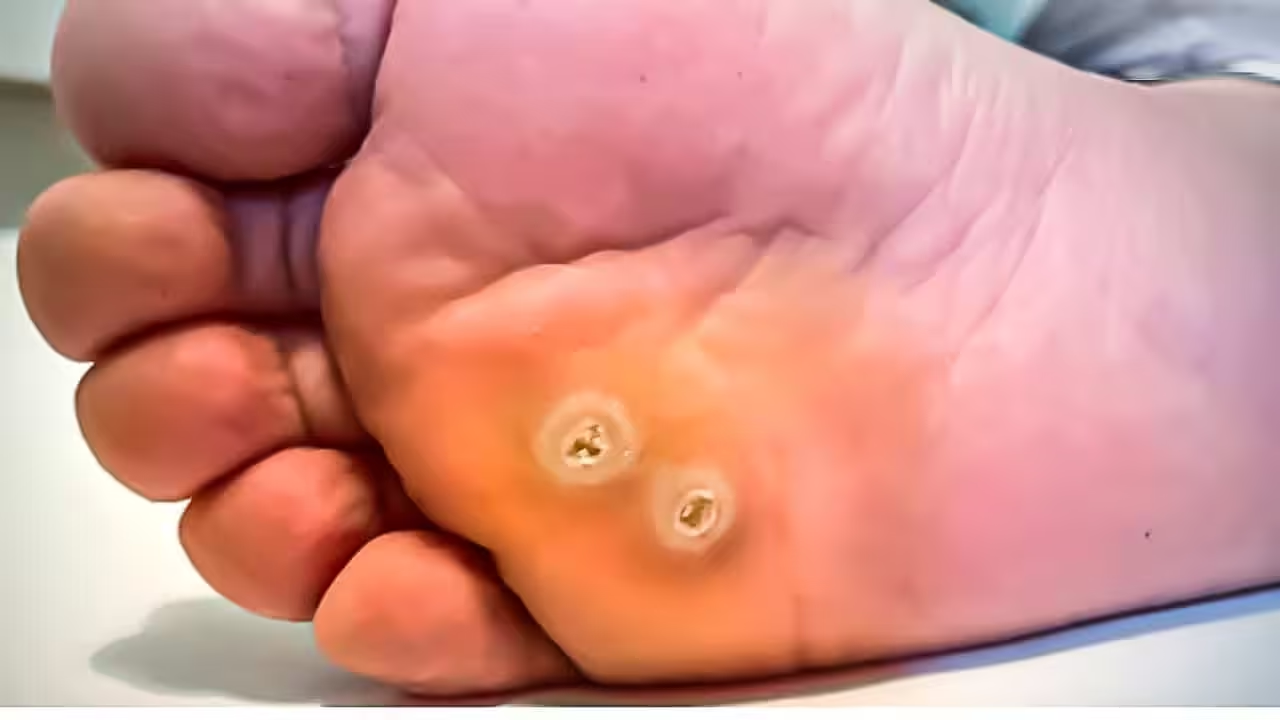
- Plantar (palmoplantar) psoriasis. Thick, hyperkeratotic, often deeply fissured plaques on the soles u2014 the most disabling form because every step reopens the cracks. Often confused with calluses or chronic athlete’s foot.
- Palmoplantar pustular psoriasis (PPP). Crops of sterile yellow-then-brown pustules on the soles, sometimes with redness and scale. Despite looking infected, no organism grows on culture. Strongly associated with smoking; quitting often improves it.
- Psoriatic nail disease. Pitting (tiny dimples in the nail plate), oil spots (translucent yellow-orange spots under the nail), onycholysis (lifting of the nail from the bed), subungual debris, and crumbling. Up to 50% of psoriasis patients have nail involvement; in those with psoriatic arthritis, the rate exceeds 80%.
- Inverse psoriasis. Smooth, red plaques in the web spaces and between the toes u2014 lacks the typical scale because the moisture sloughs it off. Frequently misdiagnosed as tinea pedis or candidiasis.
- Plaque psoriasis on the dorsal foot. Classic well-defined red plaques with silver scale on the tops of the feet, often with overlap onto the ankles.
Symptoms: how it looks and feels
The classic symptoms of foot psoriasis are red, sharply demarcated plaques with silver-white scale, often painful fissures in the heels and forefoot, itching that is usually milder than eczema, and a thickened, crumbled toenail with pitting or oil spots. Patients describe the soles as feeling like “walking on fire” or “walking on glass,” especially after long days of standing. Bleeding from fissures is common; sandal-wear becomes embarrassing; some patients stop exercising because every workout reopens the cracks. The Auspitz sign (pinpoint bleeding when scale is removed) is a useful bedside finding.
Severity varies hugely u2014 some patients have a single fingernail-sized plaque on one heel, others have the entire plantar surface involved with crippling fissures and disabling pain. The PASI (Psoriasis Area and Severity Index) and the dermatologist-favored DLQI (Dermatology Life Quality Index) are used to grade severity and to qualify patients for systemic therapy.
Causes and triggers
Psoriasis is fundamentally an autoimmune condition in genetically predisposed people. Major triggers and aggravators include:
- Streptococcal infection (especially guttate psoriasis after strep throat in young patients)
- Stress (probably via cortisol/HPA axis modulation of immune signaling)
- Smoking (strongest single risk factor for palmoplantar pustular psoriasis)
- Alcohol
- Skin trauma (Ku00f6bner phenomenon u2014 cuts, scratches, and surgical incisions can develop new plaques)
- Medications: lithium, beta-blockers, antimalarials, NSAIDs, ACE inhibitors, IFN-alpha, abrupt withdrawal of systemic steroids
- Obesity and metabolic syndrome (psoriasis is associated with increased cardiovascular risk)
What it’s NOT: athlete’s foot, eczema, contact dermatitis
Differential diagnosis is the entire game with foot psoriasis because so many conditions share the look and so many patients have been on the wrong treatment for years.
- Tinea pedis (athlete’s foot). Usually starts in the web spaces, has scaly border with central clearing, KOH-positive on microscopy. Foot psoriasis is sharply demarcated, has silver scale, often involves the nail with classic pitting/oil spots, and is KOH-negative. The two coexist often u2014 KOH and culture should be done before committing to a psoriasis diagnosis.
- Eczema (atopic dermatitis). Less sharply demarcated, more itchy, often with personal or family history of allergic rhinitis or asthma. Can be hard to distinguish from psoriasis on the foot u2014 sometimes biopsy is needed.
- Contact dermatitis. Sharply localized to the area of contact (often a shoe lining or sock dye), itchy, weeping in acute phase, resolves with allergen avoidance. Patch testing identifies the culprit.
- Hyperkeratosis/calluses. Mechanical, non-inflammatory, occur over pressure points, do not have erythema or scale.
- Dyshidrotic eczema (pompholyx). Tiny, deep-seated, intensely itchy vesicles on the sides of the toes and soles u2014 acute episodes triggered by stress, sweat, allergens.
- Reiter’s syndrome (reactive arthritis with keratoderma blennorrhagicum). Pustular plaques on the soles in a patient with conjunctivitis, urethritis, and arthritis. Rare but important.
How a podiatrist diagnoses foot psoriasis
- Targeted history. Family history of psoriasis, scalp/elbow/knee involvement, stress, smoking, recent strep, medication review.
- Skin exam. Sharply demarcated plaques with silver scale, Auspitz sign, Ku00f6bner phenomenon, fissures, location pattern.
- Nail exam. Pitting, oil spots, onycholysis, subungual debris, splinter hemorrhages.
- KOH preparation and fungal culture. Rules out concurrent or alternative tinea pedis.
- Joint exam. Tender DIP joints, sausage digit (dactylitis), enthesitis at Achilles or plantar fascia u2014 screening for psoriatic arthritis.
- Punch biopsy. Reserved for unclear cases. Shows parakeratosis, regular acanthosis, and microabscesses (Munro abscesses) of neutrophils u2014 diagnostic.
- PASI/BSA scoring. Quantifies severity for systemic therapy qualification.
Topical therapy
First-line treatment for mild-to-moderate plantar psoriasis is high-potency topical corticosteroids (clobetasol propionate 0.05% ointment or halobetasol). Because plantar skin is thick, the strongest classes are needed and tolerated. We typically prescribe twice-daily application for 2u20134 weeks, then taper to maintenance with a vitamin D analog (calcipotriene) to spare steroid use. Combination products containing both calcipotriene and betamethasone (Taclonex, Enstilar foam) are effective. Adjunctive therapies include tazarotene (a retinoid), tar preparations, and occlusion therapy (covering the steroid with cling film at night to dramatically increase potency on thick plantar skin).
Daily use of a thick emollient u2014 we recommend products containing urea or salicylic acid for keratolysis u2014 is essential. Daily soaking in lukewarm water for 10 minutes followed by gentle paring of thick scale with a pumice stone, then immediate moisturizer application, is part of the protocol. Footwear matters u2014 closed, non-breathable shoes worsen disease.
Phototherapy
Targeted excimer laser (308 nm) and narrow-band UVB (NB-UVB) are effective for plantar psoriasis when topicals fail or when disease is too widespread for cream alone. Treatment is typically 2u20133 sessions per week for 8u201312 weeks. Plantar disease often requires local PUVA (psoralen plus UVA) for the deeper response that NB-UVB cannot reach in thick palmoplantar skin. Phototherapy is administered by dermatology or specialized centers; we coordinate referral.
Systemic therapy & biologics
For severe palmoplantar psoriasis or psoriatic arthritis, systemic therapy is the standard of care. The traditional agents u2014 methotrexate, cyclosporine, acitretin, apremilast u2014 remain useful but have given way to biologics for moderate-to-severe disease. The biologic classes:
- TNF-alpha inhibitors: adalimumab (Humira), etanercept (Enbrel), infliximab (Remicade) u2014 first generation, work for both skin and joint disease.
- IL-17 inhibitors: secukinumab (Cosentyx), ixekizumab (Taltz), brodalumab (Siliq) u2014 effective skin clearance, modestly slower for joint.
- IL-23 inhibitors: guselkumab (Tremfya), risankizumab (Skyrizi), tildrakizumab (Ilumya) u2014 newest class, excellent durable response, dosed every 8u201312 weeks.
- JAK inhibitors: deucravacitinib (Sotyktu) u2014 oral, useful for moderate disease.
These medications are prescribed by dermatologists or rheumatologists, but we often initiate the referral conversation in our clinic when we recognize that the patient’s plantar disease is severe enough to qualify. Insurance generally requires documented failure of two topical agents and either methotrexate or apremilast before approving a biologic.
Treating psoriatic nails
Psoriatic nails are notoriously hard to treat and slow to respond u2014 expect 6u201312 months for visible improvement because nails grow at 1.5 mm per month and the entire nail plate must replace itself. Topical options include tazarotene 0.1% gel, clobetasol nail lacquer, and calcipotriene. Intralesional steroid injection into the proximal nail fold (a painful but effective procedure) helps focal disease. Pulsed dye laser targeting the nail bed shows promise. The most reliable durable nail clearance comes from biologics, particularly guselkumab and ixekizumab, which have nail-specific outcome data.
Important: psoriatic nail disease can mimic onychomycosis (fungal nail) so closely that even experienced clinicians get fooled. Always KOH and PAS-stained nail clipping before committing to oral antifungal therapy in a patient with cutaneous psoriasis u2014 you can treat both if both are present, but you cannot cure nail psoriasis with terbinafine.
Psoriatic arthritis warning signs
Up to 30% of psoriasis patients develop psoriatic arthritis, often after the skin disease appears. Foot involvement is common as a presenting site. Watch for: morning stiffness over 30 minutes, dactylitis (“sausage toe”), enthesitis at the Achilles or plantar fascia insertion, asymmetric DIP joint pain, persistent low back pain in young adults. Early DMARD or biologic therapy prevents permanent joint damage.
Footwear & daily care
- Breathable, cushioned, wide-toebox shoes u2014 avoid sweaty closed-toe shoes that worsen disease
- Moisture-wicking socks changed daily; avoid synthetics that trap heat
- Cushioned arch-supporting insole (PowerStep Pinnacle Maxx) to reduce Ku00f6bner trauma [Amazon]
- Daily 10-minute lukewarm soak followed by gentle scale debridement and emollient
- Avoid harsh soaps and hot water (worsen scaling); use gentle synthetic detergent cleansers
- Smoking cessation (especially for pustular psoriasis) and moderation of alcohol
Red flags: when to be seen today
- Sudden generalized pustular eruption with fever (von Zumbusch generalized pustular psoriasis u2014 dermatologic emergency)
- Painful, swollen finger or toe (“sausage digit”) in a patient with psoriasis (psoriatic arthritis)
- Severe fissuring with bleeding, drainage, fever (secondary bacterial infection)
- New skin lesions appearing rapidly during or after starting a new medication
- Constant night-time joint pain in a psoriasis patient (active arthritis or other rheumatologic emergency)
Book online or call (810) 206-1402 or your dermatologist today.
The most common mistake we see
The most common mistake we see is patients spending years on over-the-counter and prescription antifungal therapy for what is actually plantar psoriasis. The clinical clue that should reframe the diagnosis: a “fungus” that does not respond to two consecutive 4-week courses of topical antifungal, that has KOH-negative scrapings, that has classic nail pitting or oil spots, and that involves the elbows, knees, scalp, or umbilicus elsewhere on the body. Get the KOH and culture done up front, examine the nails carefully, and ask about psoriasis elsewhere on the body. Years of antifungal cream are wasted years u2014 the right diagnosis lets us start the right ladder (high-potency steroid + vitamin D analog u2192 phototherapy u2192 biologic) and get the patient comfortable. The second most common mistake is missing psoriatic arthritis. Every patient with foot psoriasis needs a brief joint screen for dactylitis, enthesitis, and DIP tenderness u2014 because catching arthritis early prevents permanent joint damage.
In-Office Treatment at Balance Foot & Ankle
If home treatment isn’t providing relief for your foot skin conditions, our podiatry team at Balance Foot & Ankle can help with expert evaluations and advanced in-office care.
VitaMedica Arnica Gel
Natural topical relief I recommend for sore feet: an arnica gel with 15 homeopathic ingredients and soothing aloe. Massage a thin layer into the sore area.
Shop VitaMedica Arnica Gel →Frequently asked questions
Is foot psoriasis contagious?
No. Psoriasis is an autoimmune condition, not an infection. You cannot catch it from someone, transmit it through skin contact, or spread it to other parts of your own body through scratching (although the Ku00f6bner phenomenon can develop new plaques at sites of skin trauma). It is genetic in roughly one-third of cases.
Can foot psoriasis be cured?
There is no permanent cure for psoriasis. However, modern treatment can clear or near-clear the skin in 80u201390% of patients on appropriate therapy, especially with biologics. Many patients achieve long, multi-year periods of complete skin clearance. Disease may flare with stress, infection, smoking, or medication changes u2014 ongoing maintenance is part of life with psoriasis.
How is foot psoriasis different from athlete’s foot?
Athlete’s foot (tinea pedis) is a fungal infection u2014 caused by dermatophytes, KOH-positive on microscopy, treated with antifungal cream or pill. Foot psoriasis is autoimmune u2014 KOH-negative, treated with steroid plus vitamin D analog, often with associated nail pitting and family history. Athlete’s foot tends to start in the web spaces; psoriasis is more often on the soles and tops with sharply demarcated plaques. The two can coexist; a KOH plus culture should be done before committing to a diagnosis.
What is the best treatment for plantar psoriasis?
For mild-to-moderate disease: high-potency topical corticosteroid (clobetasol) twice daily for 2u20134 weeks, transitioning to a combination calcipotriene-betamethasone product for maintenance, plus daily emollient and gentle scale debridement. For moderate disease: add targeted excimer laser or narrow-band UVB. For severe disease: biologic therapy (IL-17 or IL-23 inhibitor) is the standard. Smoking cessation is critical for pustular forms.
Should I see a dermatologist or a podiatrist for foot psoriasis?
Both have a role. A podiatrist is often the first to diagnose foot psoriasis (especially nail involvement) because patients present for foot pain or “fungal nails.” We initiate first-line therapy and screen for psoriatic arthritis. A dermatologist manages widespread disease, prescribes phototherapy, and writes biologic prescriptions. For psoriatic arthritis, a rheumatologist is essential. We coordinate the referral when needed.
What triggers a foot psoriasis flare?
Common triggers include stress, strep throat or other infection, skin trauma (cuts, scrapes, surgical incisions), smoking (especially pustular form), alcohol, cold dry weather, and certain medications (lithium, beta-blockers, antimalarials, abrupt steroid withdrawal). Identifying personal triggers and reducing them is part of long-term management.
The bottom line
Foot psoriasis is one of the most under-diagnosed and over-mistreated skin conditions we see. Years of antifungal therapy on what is actually an autoimmune disease leaves patients in pain and frustrated. The right protocol u2014 high-potency topical steroid plus vitamin D analog, occlusion, KOH and culture to rule out concurrent fungus, and a screen for psoriatic arthritis u2014 changes lives. For severe or unresponsive disease, biologics offer durable near-clearance. Call us at (810) 206-1402 or book online; we’ll diagnose accurately and coordinate dermatology and rheumatology where needed.
expert evaluation for foot psoriasis, psoriatic nails, and psoriatic arthritis screening. KOH and culture on site; coordinated dermatology and rheumatology referral when needed.
Sources
- Menter A, Korman NJ, Elmets CA, et al. Guidelines of care for the management of psoriasis and psoriatic arthritis. J Am Acad Dermatol. 2019;80(4):1029u20131072. PubMed
- Engin B, Askyu0131n A, Tu00fczer C, et al. Palmoplantar psoriasis. Clin Dermatol. 2017;35(1):19u201327. PubMed
- Reich K, Burden AD, Eaton JN, et al. Efficacy of biologics in the treatment of moderate to severe palmoplantar psoriasis. Br J Dermatol. 2020;182(1):24u201333. PubMed
- Ritchlin CT, Colbert RA, Gladman DD. Psoriatic arthritis. N Engl J Med. 2017;376(10):957u2013970. PubMed
- Singh S, Taylor C, Kornmehl H, Armstrong AW. Psoriasis and suicidality: a systematic review and meta-analysis. J Am Acad Dermatol. 2017;77(3):425u2013440. PubMed
Ready to fix this for good?
Reading goes only so far. The fastest path to relief is a 30-minute office visit with Dr. Biernacki — Howell or Bloomfield Township. Call (810) 206-1402 or use our online booking.
Telling foot psoriasis from the conditions it mimics
Plantar psoriasis and chronic athlete’s foot look alike and are treated in opposite directions, so the distinction matters more than it first appears. Psoriasis tends to be sharply demarcated, roughly symmetrical, silvery-scaled, and accompanied by nail pitting, oil-drop discolouration, or plaques at the elbows, knees or scalp. A fungal infection is more often asymmetrical, itchy, moccasin-distributed and paired with maceration in the toe webs. Applying a potent steroid to an undiagnosed fungal infection makes it considerably worse, which is why a skin scraping or a nail clipping is worth doing before committing to long-term treatment. Nail involvement is where the two overlap most, and nail psoriasis is frequently treated for months as toenail fungus with no result at all. If plantar skin has not responded after eight weeks, the diagnosis rather than the strength of the cream is usually the problem.
Balance Foot & Ankle sees patients at two Michigan offices: our Howell podiatry office, serving Livingston County, and our Bloomfield Township podiatry office, serving Bloomfield Hills, Birmingham, Pontiac and the rest of Oakland County. Dr. Tom Biernacki sees patients at both. Book online or call (810) 206-1402 to book an appointment.

Dr. Tom Biernacki, DPM is a board-certified foot & ankle surgeon (ABFAS & ABPM) at Balance Foot & Ankle Specialists in Southeast Michigan. With over a decade of clinical experience, he specializes in heel pain, bunions, diabetic foot care, sports injuries, and minimally invasive surgery. Dr. Biernacki is a member of the APMA and ACFAS, and his patient education content on MichiganFootDoctors.com and YouTube has made him one of the most-followed foot & ankle educators on YouTube.